


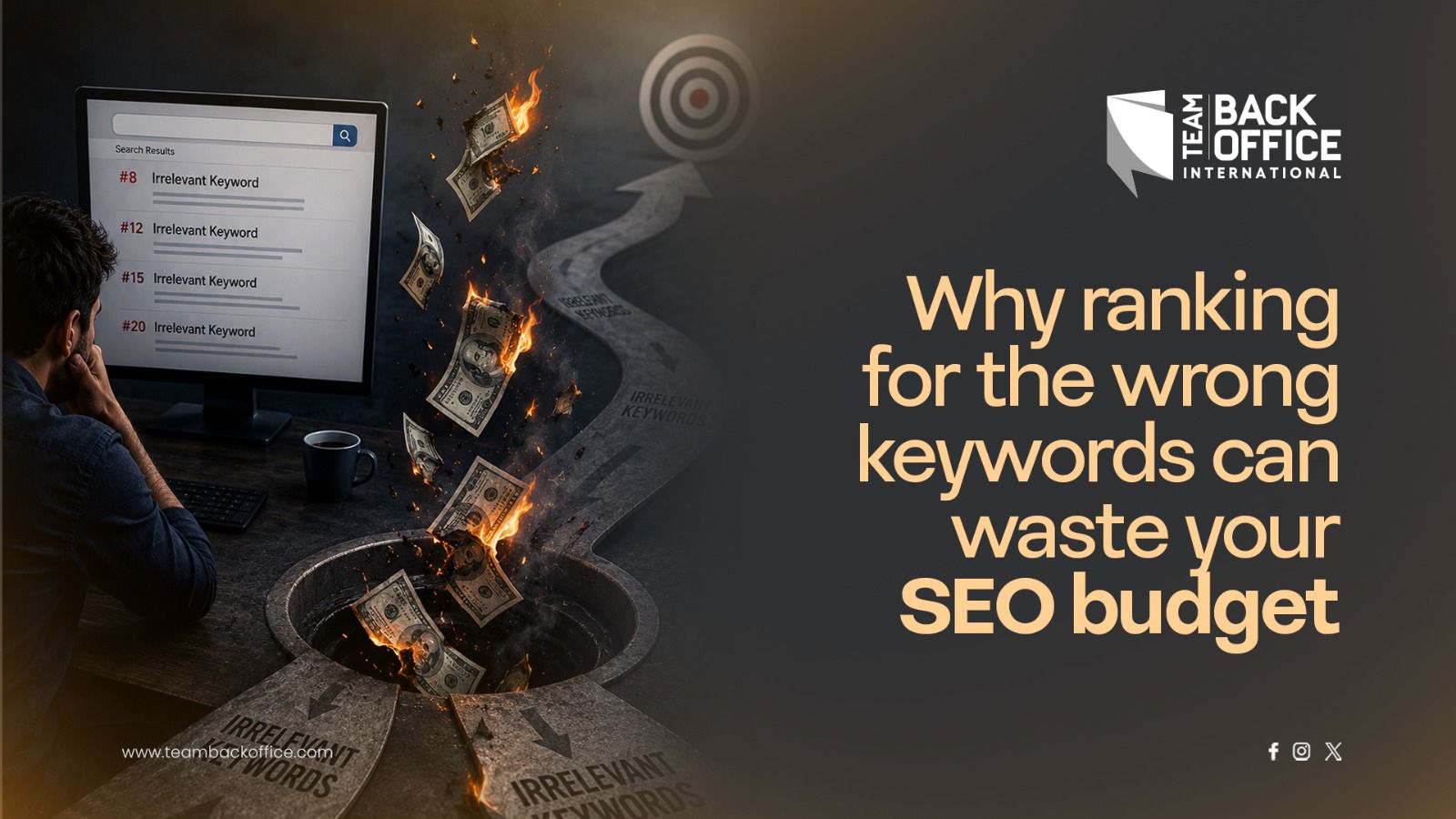
Why Ranking for the Wrong Keywords Can Waste Your SEO Budget
Quick Answer
Ranking on Google does not automatically mean your SEO is working. If your website ranks for keywords that don’t match your products, services, location, or customer intent, the traffic may generate little business value. Effective SEO focuses on relevant keywords that attract people who are more likely to engage, enquire, or become customers.
Imagine telling a business owner:
“Your website is ranking on the first page of Google.”
Sounds like good news.
Then you ask:
“For what keyword?”
And suddenly, the conversation changes.
Because ranking is only one part of SEO.
A website can rank for hundreds or even thousands of keywords and still generate very few useful enquiries.
The problem isn’t necessarily the SEO work. Sometimes, the problem is what the business is trying to rank for in the first place.
A keyword can have thousands of searches and still be almost worthless to a particular business. Another keyword might have only a few hundred searches but bring visitors who are genuinely ready to become customers.
That’s why keyword selection matters.
Not Every Search Is a Business Opportunity
Let’s say you run a company that provides ERP implementation services.
You might be able to rank for a broad keyword such as:
“What is ERP?”
It could attract a large number of visitors. But how many of them are actually looking for an ERP implementation partner?
- Some might be students.
- Some might be researching for an assignment.
- Some might simply be curious.
- Others may already know what ERP is but have no intention of buying anything.
Now compare that with:
“ERP implementation company in Kerala”
The search volume may be much smaller. But the person searching it has a completely different intention. They’re potentially looking for a service provider.
That’s the difference between traffic and relevant traffic.
Search Intent Matters More Than Search Volume
Before targeting a keyword, ask: “Why is someone searching this?”
Search intent generally falls into different categories:
1. Informational Intent
The person wants to learn something.
Examples:
- What is ERP?
- How does SEO work?
- What is GST reconciliation?
2. Commercial Research
The person is comparing options.
Examples:
- Best ERP software for manufacturing
- ERPNext vs Tally
- Best digital marketing agency for startups
3. Transactional Intent
The person is closer to taking action.
Examples:
- ERP implementation company
- Website development company
- GST consultant near me
4. Navigational Intent
The person is looking for a specific website or business.
Understanding the intent behind a keyword helps determine whether that search is useful for your business.
High Search Volume Can Be Misleading
High-volume keywords look attractive in SEO reports.
Imagine two keywords:
- Keyword A: 20,000 monthly searches
- Keyword B: 500 monthly searches
At first glance, Keyword A looks much better. But suppose Keyword A is a general informational search, while Keyword B is searched primarily by people looking for the exact service you provide.
If Keyword B produces five serious enquiries and Keyword A produces none, which one would you rather rank for?
The answer is obvious. SEO shouldn’t be a competition to collect the largest number of visitors. It should help attract the right visitors.
Ranking for the Wrong Location
Local businesses face another common problem.
Suppose your business serves customers in Kerala. You rank well for a keyword searched mainly by people in another state or country. Technically, your ranking looks impressive. Practically, it may do very little.
Location matters for businesses where customers need to physically visit, where services are region-specific, or where the company operates within particular markets.
A local business should consider whether the traffic it attracts can realistically become a customer.
Broad Keywords Can Bring the Wrong Audience
Broad keywords aren’t always bad. But they can be difficult to convert.
Consider a company that sells business software. Ranking for “software” would probably attract an enormous range of searches. But the audience is too broad.
Someone searching for photo-editing software and someone searching for business management software have completely different needs.
A more specific keyword gives search engines and users a clearer idea of what the page is about. Specificity can sometimes be more valuable than volume.
One Keyword Doesn’t Fit Every Page
Another common mistake is trying to make one keyword responsible for an entire website.
Your homepage, service pages, product pages, blogs, and location pages have different purposes:
- A website development service page might target terms related to website development.
- A blog might target an informational question.
- A specific product page should focus on that product.
- A location page may target a service combined with a location.
Each page should have a clear purpose.
Keyword Cannibalisation Can Create Confusion
Sometimes businesses create several pages targeting almost the same keyword. For example:
- Best Digital Marketing Company
- Top Digital Marketing Company
- Digital Marketing Agency
- Best Digital Marketing Agency
If several pages are competing for essentially the same search intent, the website can create unnecessary overlap.
A clear content structure helps search engines understand which page should serve which purpose. Instead of creating five similar pages, it may be better to build one strong page and support it with relevant content.
Keywords Need to Match the Actual Business
This sounds obvious. But it gets overlooked.
A keyword may have excellent search volume and relatively low competition. That doesn’t automatically make it a good target.
Ask: Do we actually provide what this searcher wants?
If the answer is no, ranking for the keyword may not help. SEO should reflect the business—not the other way around.
What About Keywords With Low Search Volume?
Don’t automatically ignore them.
Some highly specific keywords have low search volume because fewer people search for them. But those people may have very strong buying intent.
For example, “ERPNext implementation for manufacturing company” will naturally have fewer searches than “ERP software.” But someone searching the first phrase has already given you much more information about what they need.
These specific searches are often referred to as long-tail keywords. They can be valuable parts of an SEO strategy.
Your Existing Customers Can Help You Find Better Keywords
Keyword research shouldn’t happen entirely inside an SEO tool. Talk to the people who speak to customers.
Ask your sales team:
- What do prospects call our service?
- What questions do they ask?
- What problems are they trying to solve?
- What words do they use when describing their needs?
The language customers use can reveal keyword opportunities that generic tools may not make obvious.
Your customer support team can also provide useful information. Repeated questions often make excellent content topics.
Look Beyond Rankings
A good SEO report shouldn’t only say: “We moved from position 12 to position 5.” That’s useful information, but it isn’t the whole story.
You should also look at:
- Organic traffic
- Relevant traffic
- Search impressions
- Click-through rate
- Enquiries
- Leads
- Conversions
- Engagement
- Revenue where measurable
The important question is: “What happened to the business because of the SEO work?”
How to Choose Better Keywords
Before targeting a keyword, evaluate it against five questions:
1. Is it relevant?
Does it directly relate to what your business offers?
2. Does the search intent match?
Is the person looking for information, comparison, or a solution you provide?
3. Can we realistically compete?
Consider your website’s authority, content quality, competition, and resources.
4. Can the keyword attract the right audience?
Search volume alone doesn’t tell you who is searching.
5. What happens after they click?
Does the landing page actually answer their question or provide the solution they’re looking for?
If the answer to these questions is positive, the keyword has a stronger business case.
Don’t Let SEO Become a Vanity Project
There is nothing wrong with celebrating a first-page ranking. But rankings shouldn’t become the final goal.
If a keyword brings thousands of visitors who never need your service, the number can look impressive while contributing very little to the business.
A smaller amount of highly relevant traffic can be much more valuable. SEO should ultimately support something beyond the search results page—it should support the business.
Final Thoughts
The goal of SEO isn’t to rank for as many keywords as possible. It’s to become visible when the right people are searching for what your business offers.
A keyword with 10,000 searches isn’t automatically better than one with 500. A first-page ranking isn’t automatically a success. And a large traffic graph doesn’t necessarily mean your SEO investment is paying off.
The right keyword connects three things:
- What people search for.
- What your business provides.
- What the searcher intends to do next.
When those three align, SEO becomes much more than a rankings exercise. It becomes a way of bringing the right potential customers to your business.
Don’t chase the biggest keyword. Chase the most valuable one.
Frequently Asked Questions
What is the biggest keyword mistake businesses make?
One common mistake is choosing keywords based primarily on search volume. A keyword can generate substantial traffic but still be irrelevant to the business or attract people who have no intention of becoming customers.
Is high search volume always better for SEO?
No. High search volume means more people search for a term, but it doesn’t indicate whether those people are relevant to your business. A lower-volume keyword with strong commercial intent can generate more valuable traffic and leads.
What is search intent?
Search intent refers to the reason behind a user’s search. They may be looking for information, comparing products or services, trying to complete an action, or looking for a specific business or website.
What are long-tail keywords?
Long-tail keywords are generally more specific search phrases that tend to have lower search volume than broad terms. They can be valuable because they often describe a more specific need or search intent.
How do I know if an SEO keyword is valuable?
Consider relevance, search intent, competition, audience quality, and what happens after someone clicks the result. Also measure whether the keyword contributes to meaningful actions such as enquiries, leads, or sales.
Can a website rank for a keyword that isn’t relevant to its business?
Yes. Search engines may rank pages for terms that appear in or relate to their content even when those searches aren’t valuable to the business. Ranking alone doesn’t guarantee useful traffic.
Should every website page target a different keyword?
Not necessarily. Pages should have distinct purposes and search intents. Similar pages targeting the same intent can overlap, while related keywords can often be covered naturally within a well-structured page.
About the Author
Adarsh P is a Digital Marketing Analyst at Team Back Office, with experience in SEO, keyword research, digital analytics, and performance marketing. His work focuses on using search data and performance insights to build digital strategies that connect business goals with the right audiences.